


Saving Schemes in India - 2026
What is Saving Schemes?
Saving schemes in India are government-backed financial plans designed to encourage citizens to save and earn returns at attractive interest rates. Options like the Public Provident Fund (PPF), National Savings Certificate (NSC), and Senior Citizens Savings Scheme (SCSS) offer tax deductions and benefits under the Income Tax Act, 1961. These schemes cater to various financial goals, such as retirement, education, and emergency funds, and are considered safe due to government backing.

List of Saving Schemes in India 2026
The following table highlights the details of savings schemes:
Savings Scheme | Interest Rate | Contribution Amount | Duration |
4.0% | Minimum: Rs.500, Maximum: No Limit | No limit | |
Post Office Monthly Income Scheme | 7.4% | Minimum: Rs.1,000, Maximum: Rs.9 lakh | 5 years |
Post Office Recurring Deposit | 6.7% | Minimum: Rs.100, Maximum: No limit | 5 years |
Post Office Time Deposit (One Year) | 6.9% | Minimum: Rs.1000, Maximum: No limit | 1 year |
Post Office Time Deposit (Two Years) | 7.0% | Minimum: Rs.1000, Maximum: No limit | 2 years |
Post Office Time Deposit (Three Years) | 7.1% | Minimum: Rs.1000, Maximum: No limit | 3 years |
Post Office Time Deposit (Five Years) | 7.5% | Minimum: Rs.1000, Maximum: No limit | 5 years |
Kisan Vikas Patra (KVP) | 7.5% | Minimum: Rs.1000, Maximum: No limit | 9 years & 5 months |
Public Provident Fund (PPF) | 7.1% | Minimum: Rs.500, Maximum: Rs.1.5 lakh p.a. | 15 years |
8.2% | Minimum: Rs.250, Maximum: Rs.1.5 lakh p.a. | 15 years contribution periodMaturity period at 18 or 21 years of girl child | |
7.7% | Minimum: Rs.1,000, Maximum: No Limit | 5 years | |
Market Linked | Govt employees: 14%Others: 10% | Up to 60 years of age but can be extended up to 70 | |
Market Linked | Minimum: Rs.1,000, Maximum: No Limit | 5 years | |
8.2% | Minimum: Rs.1,000, Maximum: Rs.30 lakh | 5 years | |
Tax Saving FDs | 5.5% to 7.75% | Minimum: Rs.100, Maximum: Rs.1.5 lakh per financial year | 5 years |
Advantages of Savings Schemes
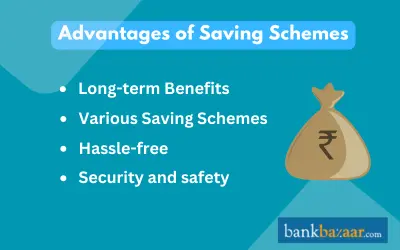
The main advantages of investing in savings schemes are mentioned below:
- Long-term benefits: Individuals can achieve their long-term goals such as retirement plans, children's education, and children's marriage by investing in savings schemes.
- Various savings schemes: The number of savings scheme currently available is large. The benefits vary according to the scheme and the sector. For example, the Pradhan Mantri Jan Dhan Yojana is designed to help people who are below poverty line and the Sukanya Samriddhi Yojana helps a girl child financially.
- Hassle-free: The maintenance and investment towards the schemes are very simple and most of the contributions made towards the schemes can be done online.
- Security and safety: The contributions that are made towards the schemes are minimal on risk as well as safe and secure since the schemes are launched by the Indian Government.
Different Types of Savings Schemes
Some of the various schemes that are available are mentioned below:
Scheme Name | Key Features | Returns & Tax Benefits |
Tax Saving FDs | Lock-in: 5 years; Bank FDs eligible for Sec 80C; Min ₹100 | 5.75% - 8.60%; Interest taxable; ₹1.5L max deduction |
ULIP | Life cover + investment; Equity/debt mix; Min ₹2,500 annually | Market-linked returns; Tax-free maturity; Deduction under Sec 80C |
ELSS (Mutual Funds) | 3-year lock-in; Invests in equities; Min ₹100 | Market returns; 10% LTCG tax; Deduction up to ₹1.5L under Sec 80C |
Public Provident Fund (PPF) | 15-year lock-in; Extendable in blocks of 5 years; Open in banks or post offices | 7.1% (FY 2025-26); Tax-free returns; Eligible under Sec 80C |
EPF (Employees’ PF) | Employer + employee contribute; Mandatory for large employers | 8.25%; Tax-free; Sec 80C eligible |
NPS (National Pension System) | Long-term retirement scheme; Till age 60; Partial annuity + lump sum | 4%–9% returns; Partial tax on maturity; Sec 80C + 80CCD(1B) benefit |
Sukanya Samriddhi Yojana | For girl child; 21-year maturity; Min ₹250/year | 8.2%; Completely tax-free; Sec 80C benefit |
Atal Pension Yojana (APY) | Govt-backed pension for low-income earners; Min 20-year contribution | Fixed pension on retirement; Taxable; Eligible under Sec 80CCD |
Voluntary Provident Fund (VPF) | Employee can contribute entire basic salary voluntarily | 8.15%; Tax-free; Sec 80C eligible |
Kisan Vikas Patra (KVP) | Money doubles in 115 months; Min ₹1,000; Post office only | 7.5%; No Sec 80C benefit; Interest is taxable |
Senior Citizens Savings Scheme | For age 60+; 5-year lock-in; Min ₹1,000 and max ₹15 lakh | 8.2%; Interest taxable; Sec 80C eligible |
National Savings Certificate | Govt-backed; 5-year tenure; Min ₹100; Only available at post offices | 7.7%; Sec 80C benefit; Interest compounded annually and reinvested |
Post Office Savings Account | Simple savings; Accessible across India; Min ₹50 | 4% interest; Interest is taxable; No tax deduction |
Post Office Recurring Deposit | 5-year RD; Min ₹10 monthly; Option to extend for 5–10 years | 6.5%; Interest fully taxable; No Sec 80C benefit |
Mahila Samman Bachat Patra | One-time scheme for women/girls; Max ₹2 lakh; Partial withdrawal allowed | 7.5% for 2 years; Interest is tax-free; No Sec 80C deduction |
The savings schemes that are offered by India Post are mentioned below:
- Post Office Savings Account
- National Savings Time Deposit Account
- Senior Citizens Savings Scheme Account
- National Savings Certificate Account
- Sukanya Samriddhi Account
- National Savings Recurring Deposit Account
- National Savings Monthly Income Account
- Public Provident Fund Account
- Kisan Vikas Patra Account
FAQs on Saving Schemes in India
1. Can I get a tax rebate for investment in post office savings schemes?
Yes, you can claim a Section 80C deduction for investments made in most post office savings schemes. But this tax benefit is not applicable to investments in post office, such as Monthly Income Schemes (MIS) or recurring deposit schemes.
2.Which post office savings scheme is suitable for 5 years?
Investors who want a lock-in period of 5 years can invest in the 5-Year Post Office Recurring Deposit Account (RD).
3.Can students open a post office savings Scheme?
Yes, students above 18 years can invest in the post office saving scheme except for Sukanya Samriddhi Yojana (SSY) and Senior Citizen Savings Scheme (SCSS). This is because SSY can be opened by the girls' parents or guardian for their girl child who is below 10 years of age and SCSS can be opened only by senior citizens.
4.How to buy Kisan Vikas Patra?
To purchase a Kisan Vikas Patra, you can visit your nearest post office or authorised bank to purchase the Kisan Vikas Patra. Obtain a KVP application form (Form A) from the Post Office; fill in the required details; and submit the completed form along with necessary documents, such as address proof and proof of identity. You will receive the KVP certificate after making the payment as specified under the scheme details.
5.Which post office scheme gives 8% interest?
The Senior Citizen Savings Scheme (SCSS) and Sukanya Samriddhi Account Scheme offered by the post office provides a rate of interest of 8.20%. These schemes are specifically designed for individuals aged 60 and above and a girl child of 10 years of age, respectively. These schemes offer regular interest payouts along with a secure investment option.
6.Which savings scheme gives the highest returns?
Some of the saving schemes that offer high returns are Sukanya Samriddhi Yojana, National Savings Certificate, Public Provident Fund, Recurring Deposits (RD), Kisan Vikas Patra, etc.
7.What is a small saving scheme?
These schemes encourage saving habits while providing steady returns to the investors. These schemes are known for their safety and stability, thereby smaking them suitable for risk-averse investors. Popular mall saving schemes offered by the government include the Public Provident Fund (PPF), Sukanya Samriddhi Yojana, and National Savings Certificates (NSC).
8.What is a government saving scheme?
Government saving schemes are those schemes offered by the government that encourage the habit of savings among the citizens of the country. These schemes come with tax benefits, attractive interest rates, secure payment options, and have lower risk than other investment options.
9.What is the importance of saving scheme in India?
The savings schemes in India helps achieving long-term financial goals; ensures financial safety; helps in retirement planning; manages personal finance through monthly income scheme option; ensures tax savings; and provides easy access to the fund due to online services.
News about Saving Schemes
Union Budget 2025: Modified UDAN Scheme
Modified UDAN scheme to include 120 new destinations. The aim is to carry 4 crore additional passengers in the next 10 years. The scheme will also also support helipads and smaller airports across the country, especially in the northeastern states.
Union Budget 2025: Social Security Scheme for Welfare of Gig Workers
Under the Union Budget 2025, the Finance Minister has announced that online platform workers, approximately 1 crore workers, will be provided with identity cards as well as enrollment under the PM Jan Arogya Yojana under a new social security scheme.
Union Budget 2025: Government extends PM Research Fellowship scheme
In the 2025 Union Budget, Finance Minister Nirmala Sitharaman announced that 10,000 fellowships will be offered under the Prime Minister’s Research Fellowship (PMRF) scheme over the next five years, targeting technological research at institutions like IITs and IISc.

Disclaimer
Credit Card:
Credit Score:
Personal Loan:
Home Loan:
Fixed Deposit:


Copyright © 2026 BankBazaar.com.