


Current Repo Rate 2026
What is REPO Rate?
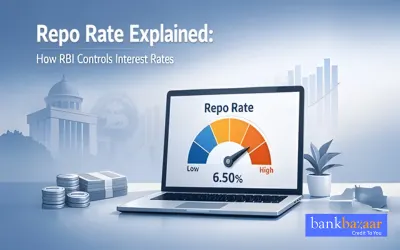
The Repo Rate is the interest rate at which the RBI lends money to commercial banks in exchange for securities to manage liquidity and control inflation. Currently at 5.25% (following a 25 basis points cut on 5 December 2025), the repo rate is a key tool RBI uses to regulate the money supply and inflation in the economy.
An agreement between the central bank and the commercial bank will be made to repurchase the securities at a price that is predetermined. This is done when banks face a shortage of funds or need to maintain liquidity in volatile market conditions. The RBI uses the repo rate to control inflation rates.
On 5 December 2025, the Reserve Bank of India (RBI) reduced the repo rate of 5.50% by 25 basis points, bringing the repo rate down to 5.25%.
The reverse repo rate stands unchanged at 3.35%.The Bank Rate and the Marginal Standing Facility (MSF) rate has changed to 5.55%. The current Standing Deposit Facility Rate is 5.00%.
RBI Repo Rate
Repo Rate | 5.25% |
Bank Rate | 5.50% |
Reverse Repo Rate | 3.35% |
Marginal Standing Facility Rate | 5.50% |
Note that the rates are applicable from 5 December 2025.
Cash Reserve Ratio (CRR): 3.00% Banks must maintain this percentage of deposits as reserve with the RBI, which helps regulate the money supply and ensure system stability.
Statutory Liquidity Ratio (SLR): 18.00% Banks are required to hold this percentage of deposits as liquid assets, ensuring their ability to meet withdrawal demands and maintain financial stability.
The December 2025 rate cut reflected the RBI's confidence in strong economic growth (7.3% FY26 GDP forecast) and very low inflation (2% estimated), coupled with measures to inject Rs.1 lakh crore through government bond purchases and a three-year USD/INR swap facility.
Find REPO Linked: Home Loan Interest Rate
RBI Repo Rate Cut History from 2005 till 2025
The change in repo rate in India since October 2005 can be summed up as follows:
Effective Date | Repo Rate | %Change |
5 December 2025 | 5.25% | 0.25% |
6 June 2025 | 5.50% | 0.50% |
9 April 2025 | 6.00% | 0.25% |
7 February 2025 | 6.25% | 0.25% |
6 December 2024 | 6.50% | |
18 September 2024 | 6.50% | - |
8 June 2023 | 6.50% | - |
8 February 2023 | 6.50% | 0.25% |
7 December 2022 | 6.25% | 0.35% |
30 September 2022 | 5.90% | 0.5% |
5 August 2022 | 5.40% | 0.5% |
8 June 2022 | 4.90% | 0.5% |
May 2022 | 4.40% | 0.4% |
09 Oct 2020 | 4.00% | 0.00% |
06 Aug 2020 | 4.00% | 0.00% |
22 May 2020 | 4.00% | 0.40% |
27 March 2020 | 4.40% | 0.75% |
6 February 2020 | 5.15% | 0.25% |
07 August 2019 | 5.40% | 0.35% |
06 June 2019 | 5.75% | 0.25% |
04 April 2019 | 6.00% | 0.25% |
07 February 2019 | 6.25% | 0.25% |
01 August 2018 | 6.50% | 0.25% |
06 June 2018 | 6.25% | 0.25% |
02 August 2017 | 6.00% | 0.25% |
04 October 2016 | 6.25% | 0.25% |
05 April 2016 | 6.50% | 0.25% |
29 September 2015 | 6.75% | 0.50% |
02 June 2015 | 7.25% | 0.25% |
04 March 2015 | 7.50% | 0.25% |
15 January 2015 | 7.75% | 0.25% |
28 January 2014 | 8.00% | -0.25% |
29 October 2013 | 7.75% | -0.25% |
20 September 2013 | 7.50% | -0.25% |
03 May 2013 | 7.25% | -0.50% |
17 March 2011 | 6.75% | -0.25% |
25 January 2011 | 6.50% | -0.25% |
02 November 2010 | 6.25% | -0.25% |
16 September 2010 | 6.00% | -0.25% |
27 July 2010 | 5.75% | -0.25% |
02 July 2010 | 5.50% | -0.25% |
20 April 2010 | 5.25% | -0.25% |
19 March 2010 | 5.00% | -0.25% |
21 April 2009 | 4.75% | 0.25% |
05 March 2009 | 5.00% | 0.50% |
05 January 2009 | 5.50% | 1.00% |
08 December 2008 | 6.50% | 1.00% |
03 November 2008 | 7.50% | 0.50% |
20 October 2008 | 8.00% | 1.00% |
30 July 2008 | 9.00% | -0.50% |
25 June 2008 | 8.50% | -0.50% |
12 June 2008 | 8.00% | -0.25% |
30 March 2007 | 7.75% | -0.25% |
31 January 2007 | 7.50% | -0.25% |
30 October 2006 | 7.25% | -0.25% |
25 July 2006 | 7.00% | -0.50% |
24 January 2006 | 6.50% | -0.25% |
26 October 2005 | 6.25% | 00.00 |
How Does Repo Rate Work?
As mentioned earlier, the repo rate is used by the central bank of India to control the flow of money in the market. When the market is hit by inflation, RBI increases the repo rate.
An increased repo rate denotes that the banks who borrow money during this period from the central bank will have to pay higher interest. This discourages the banks from borrowing money, which in turn, reduces the supply of money in the market and helps negate inflation. Similarly, the repo rates are decreased in the case of a recession.
How Does RBI Calculate Repo Rate?
On the basis of the economic condition, as discussed in the last paragraph, the RBI regulates the repo rate. The rates are decided by the central bank on the basis of inflation or recession in the market of the country.
Repo Rate vs Reverse Repo Rate
Repo Rate vs Reverse Repo Rate is one of the most important topics that we need to understand. The difference can be listed as follows:
- Repo rate is charged against funds lent by the RBI to commercial banks and other financial institutions. The reverse repo rate, on the other hand, is the rate of interest that is offered by the central bank to the commercial banks who deposit funds in the RBI treasury.
- Repo rate is always higher than the reverse repo rate.
- Repo rate helps to control the inflation in the market. The reverse repo rate, on the other hand, helps to control the supply of money in the market.
What is the Difference between the Repo rate and the MCLR rate?
Marginal Cost of funds based Lending Rate or MCLR is a reference rate which is used internally for ascertaining the interest rate which can be levied by the banks on loans. The repo rate, on the other hand, is an interest rate which is determined by the Reserve Bank of India (RBI) and charged against the funds lent by the central bank to commercial banks and all other financial institutions.
What effect does the repo rate have on the life of a common man?
The effect of repo rate on the life of common man is direct in terms of the increase in the overall interest. As discussed earlier, repo rate is the rate of interest which is charged by the RBI for funds lent to the commercial banks.
When the repo rate increases, the interest rate at which commercial banks borrow money from the central bank increases and the borrowing becomes costlier. In turn, the commercial banks increase their lending rates to cope with the hike in the repo rate. Thus, when common men borrow money from the commercial banks, the effective interest rate becomes higher and they end up paying higher interest amounts for the loan that they borrow.
What is the relationship between Inflation and Repo Rate?
The repo rate is used by the central bank of India to control the supply of money in the Indian market. A higher repo rate helps in reducing the borrowing power of the commercial banks which, in turn, reduces the flow of cash in the market. This method helps to control inflation.
Let us take an example here. Let us assume that the country has been hit by inflation and the RBI has set the repo rate at 10%. In this case, if a commercial bank is borrowing an amount of Rs.10,000 from the central bank, the interest amount for the same will be Rs.1,000.
To avoid paying this higher rate of interest, the commercial banks decide to borrow further from the RBI, which reduces the supply of cash in the market. As the flow of cash reduces in the market, the demand is not met. This helps in checking inflation and regulating it accordingly.



FAQs on Current Repo Rate
1.What is repo rate?
The Repo Rate is the interest rate at which the Reserve Bank of India (RBI) lends money to commercial banks and other financial institutions by accepting securities as collateral. This rate helps the RBI regulate money supply and control inflation in the economy.
2.What is reverse repo rate?
The reverse repo rate is the interest rate that the RBI offers to commercial banks who deposit funds in the RBI treasury. It is always lower than the repo rate and is used to absorb excess liquidity from the banking system.
3.What is the difference between repo rate and reverse repo rate?
The repo rate is charged by the RBI on funds lent to commercial banks, whereas the reverse repo rate is the interest offered by the RBI to banks depositing funds with it. Repo rate is always higher than reverse repo rate; repo rate controls inflation whilst reverse repo rate controls money supply
4.What is the Marginal Cost of Funds Based Lending Rate?
MCLR is a benchmark rate that banks use internally to determine the maximum interest rate they can charge borrowers. Unlike the repo rate which is set by the RBI, MCLR varies by bank and is based on their cost of funds.
5.What types of loans are impacted by the reduction or increase in repo rates?
Personal loans, vehicle loans, home loans, and gold loans are all impacted by changes in the repo rate. Banks often link their lending rates to the repo rate via benchmarks such as the repo-linked rates or external benchmarks.
6.How frequently will banks alter loan interest rates that are tied to the repo rate?
Reserve Bank guidelines state that interest rates based on an external benchmark interest rate must be revised every 3 months. This ensures borrowers benefit from repo rate cuts and share the impact of rate increases promptly.
7.How does the repo rate work?
The RBI uses the repo rate to control money flow in the economy. When the RBI increases the repo rate, banks pay higher interest on borrowed funds, discouraging borrowing and reducing money supply to combat inflation. Conversely, lowering the repo rate encourages borrowing and increases liquidity during recessions.
8.How does the RBI decide on repo rate changes?
The RBI's Monetary Policy Committee determines repo rate changes based on economic conditions including inflation levels, GDP growth, employment, and currency stability. The RBI aims to balance price stability with economic growth objectives.
9.What effect does the repo rate have on common people?
When the repo rate increases, banks face higher borrowing costs and pass these on to borrowers through increased interest rates on loans. Conversely, when the RBI cuts the repo rate, borrowing becomes cheaper, reducing EMIs and interest payments for home, auto, and personal loans.
10.What is the relationship between inflation and repo rate?
The RBI raises the repo rate to combat high inflation by reducing the money supply—higher borrowing costs discourage lending, cooling demand and inflation. During low inflation or recessions, the RBI cuts the repo rate to stimulate growth and increase liquidity.
11.Why did the RBI cut the repo rate in December 2025?
The RBI reduced the repo rate by 25 basis points to 5.25% on 5 December 2025 in response to strong economic growth (7.3% FY26 forecast), very low inflation (2% estimate), and to support continued economic expansion through improved liquidity.
News about Repo Rate
RBI Cuts Repo Rate to 5.25%, Raises Growth Forecast and Adds Liquidity in December Policy
The Reserve Bank of India announced its monetary policy decision on 5 December 2025, where Governor Sanjay Malhotra and the Monetary Policy Committee cut the repo rate by 25 basis points to 5.25%. The meeting took place at a time of strong economic growth, very low inflation, and a weak rupee near 90 per US dollar. The RBI raised its FY26 GDP growth forecast to 7.3% and lowered its inflation estimate to 2%. To add more money into the banking system, it announced government bond purchases worth Rs.1 lakh crore and a three-year USD/INR swap of $5 billion. The central bank noted various positive indicators, including higher FDI inflows and strong services exports, and said there may still be space for more rate cuts if inflation stays low.
Reserve Bank of India decreases repo rate by 50 basis points today on 6 June
The Reserve Bank of India (RBI) reduced the repo rate by 50 basis points to 5.50% today, 6 June 2025, marking the third consecutive rate cut this year. The RBI has also changed its policy stance to 'Neutral' and lowered the cash reserve ratio (CRR) by 100 basis points to 3%, encouraging banks to enhance lending. These measures are designed to maintain growth momentum while keeping inflation in check.

Disclaimer
Credit Card:
Credit Score:
Personal Loan:
Home Loan:
Fixed Deposit:


Copyright © 2026 BankBazaar.com.